Wolf Oven Repair
Wolf M Series Oven Light Bulb: Replace It Yourself or Call?
A dark Wolf M Series oven light is most often a spent bulb you can change yourself with the breaker off, once you match the part to the model on your serial tag. If a new bulb stays dark, the fault sits in the socket, the wiring or the light relay.
Written by Greg Lindqvist
Bench speciality: gas ignition and burners · Years at it: 18
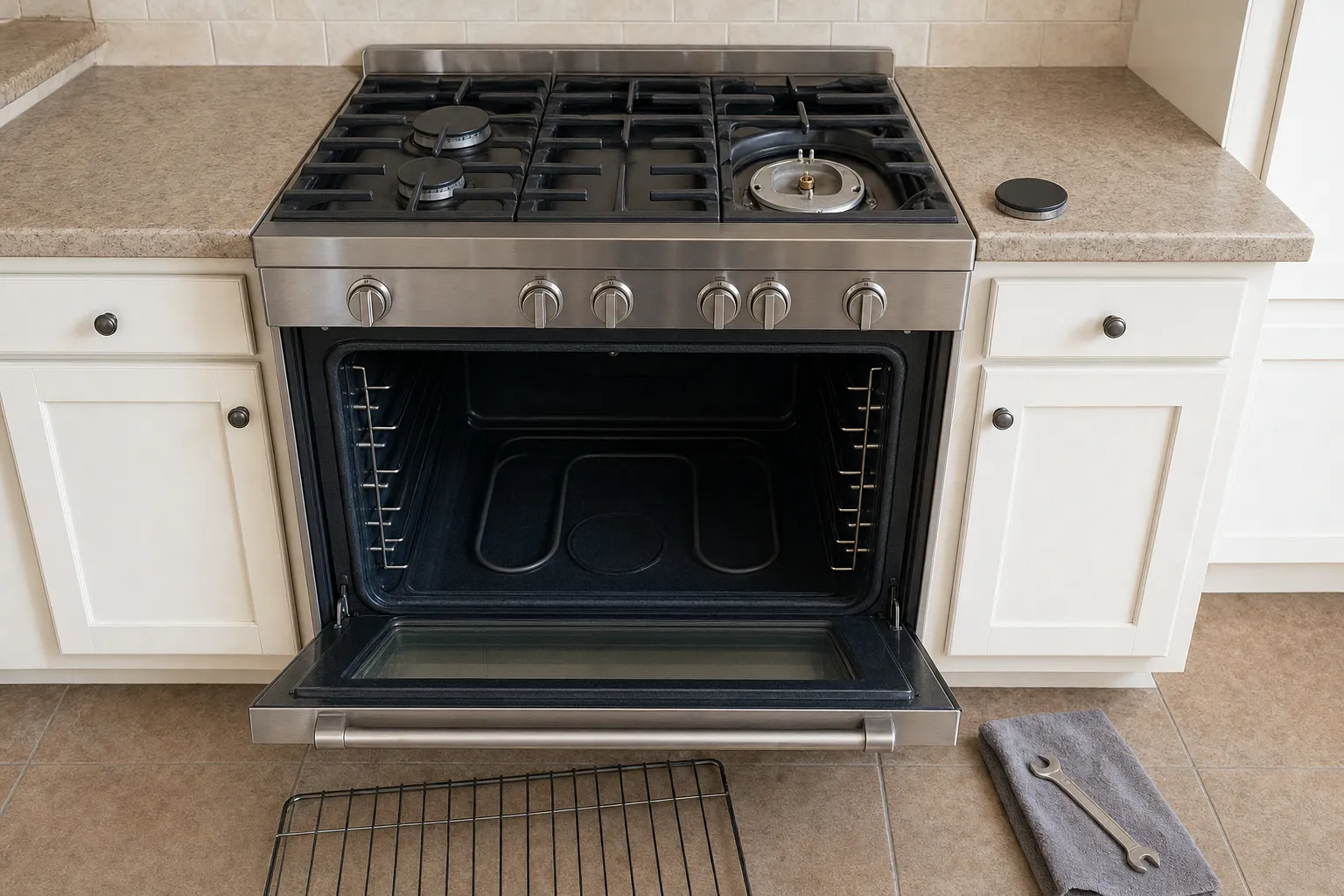
When the light inside a Wolf M Series oven goes dark, the cause is most often a burned-out bulb, and on most models an owner can swap it in a few minutes with the breaker off and the oven cold. The harder part is buying the right lamp. Plenty of people search for a part number such as 823914, but the safe move is to match any number to the model printed on your oven’s serial tag before you order. If a fresh bulb stays dark, or every lamp in the cavity quits at once, the problem lives behind the bulb, in the socket, the wiring or the relay that switches it, and that is work for a technician.
What the oven light actually does
An oven lamp is a small heat-rated bulb set in a sealed housing behind a glass lens. The lens keeps grease and steam off the bulb, and a gasket around it stops cavity heat from cooking the socket. Power reaches that socket through a wire run from the oven’s control electronics, where a relay closes when you open the door or press the light key. Most owners never think about that relay, yet it explains why a light can fail even with a perfectly good bulb.
The window light earns its keep here. Around the winter solstice the sun sets in Bellevue before half past four, so from November through February most weeknight dinners are cooked after dark. Checking a roast through the glass, instead of opening the door and letting the heat pour out, is the whole reason the lamp is there.
Finding the right bulb for your oven
Oven bulbs look alike but are not interchangeable, so identify the oven before anything else. Wolf model numbers give you the type and series at a glance. A leading SO tells you it is a single oven, while DO points to a double and CSO to a convection steam model. The letters TM, PM or CM identify an M Series oven in Transitional, Professional or Contemporary styling, and TE or PE identify an E Series.
On SO3050/DO3050 ovens from the M and E Series, the serial tag sits near the bottom trim on the left side once the door is open; on a double, look on the lower oven. Convection steam and speed ovens carry their tag on the left of the front face frame instead.
With the model in hand, open the use and care guide written for that exact oven. Wolf calls for a 40-watt halogen in the E Series and a 20-watt halogen in the older L Series, so a lamp that suits one oven can be wrong for the one beside it. Treat the M Series the same way and confirm the wattage and base in your own guide or parts list rather than ordering by number alone. Our page on common M Series oven faults covers what else tends to go wrong on that line, and the E Series page does the same for the older ovens.
How an oven light fails
Most failures fall into a short list, and the symptom usually tells you which one you are dealing with.
| What you see | Likely cause | Who fixes it |
|---|---|---|
| One lamp out, the others fine | Burned-out bulb | Usually the owner |
| New bulb dies within weeks | Oil on the glass, scorched socket, wrong wattage | Owner first, then a technician |
| Light flickers as the door moves | Loose socket or worn connection | Technician |
| Every lamp dark together | Door switch, wiring or light relay | Technician |
| Light stays on with the door shut | Door switch or a relay stuck closed | Technician |
Halogen lamps are fussy about handling. Oil from a fingertip leaves a mark on the quartz that runs hotter than the glass around it, and that mark can crack the bulb or end its life early. Sockets wear in their own way: years of heat make the contacts brittle, and once a socket stops gripping the pins firmly it arcs, flickers and burns through bulbs.
Changing a bulb yourself, safely
If your guide shows a lamp the owner is meant to reach, the job is short:
- Switch the oven off at the breaker, not only at the controls, and let the cavity cool completely.
- Slide the racks out so you can see and reach the lens.
- Ease the light cover away. Wolf’s L Series guide says to pry it gently with a flat screwdriver; never lever against the enamel or force a cover that resists.
- Pull the old bulb straight out, then fit the new one while holding it in a clean cloth or glove so no skin touches the glass.
- Refit the cover so it seats fully, restore the breaker, and test the light with the door open and closed.
Wolf’s E Series guide adds one limit worth knowing: the bulb at the top of the cavity on those ovens has to be replaced by service, not by the owner. If your lamp is overhead, or the cover will not come away under light pressure, stop and call.
When the light is a technician’s job
Book a diagnosis when a known-good bulb stays dark, when every lamp fails together, when the socket looks brown or the wiring crumbles, or when the oven shows a fault message. On legacy E Series ovens, code 07 x 22 means the oven light relay is open, and Wolf publishes no owner fix for it. On the M Series, if the controls turn erratic along with the light or the display reads Touch Pad Sensor Fault, the one step Wolf gives owners is cutting the breaker for 30 seconds; if the problem returns, the control panel assembly may need replacing.
Having a technician test the light and its circuit is billed as one $89 service call. If you then say yes to the repair, that amount is subtracted from your final total. When the relay that powers the lamps turns out to be the culprit, the work counts as control board or touch panel repair, which runs well beyond the cost of a bulb or socket. You get a firm price once the oven has been tested, before anything is replaced. We see wall ovens in homes across Downtown Bellevue, Bridle Trails, Somerset and Crossroads, and Wolf Repair Bellevue answers at (425) 629-0033.
Common follow-ups
Can I replace the light bulb in my Wolf M Series oven myself?
Usually yes, provided the lamp sits behind a cover you can reach from inside the cavity. Turn the oven off at the breaker, wait until it is fully cold, hold the new bulb in a clean cloth, and refit the cover without forcing it. If the cover will not release or the lamp is out of reach, leave it for a technician.
How do I know which bulb my Wolf oven takes?
Read the model number off the serial tag first, then check the use and care guide for that model. On SO3050/DO3050 ovens the tag is near the bottom trim on the left with the door open, on the lower oven of a double. Wolf lists a 40-watt halogen for the E Series and a 20-watt halogen for the older L Series.
Why does my Wolf oven keep blowing light bulbs?
Repeat burnouts usually trace back to skin oil on the halogen glass, a socket loosened or scorched by heat, or a lamp of the wrong wattage. Oil leaves a hot spot that shortens the bulb's life. If a correct, cleanly handled bulb dies within weeks, have the socket and its wiring checked.
Every light in my Wolf oven went out at once. Is that the bulbs?
Probably not, because separate bulbs seldom quit together. A fully dark cavity points to the parts they share: the door switch, the wiring, or the relay on the control electronics that sends them power. On legacy E Series ovens, code 07 x 22 means that light relay is open, which needs a technician.